What You’ll Learn
- What diamond fluorescence means
- Why some diamonds glow under UV light
- The colors diamonds can fluoresce
- When fluorescence affects value — and when it doesn’t
Quick Answer
Diamond fluorescence usually does not reduce a diamond’s beauty or value — and sometimes it can even enhance appearance. Only in rare cases of strong fluorescence in higher color grades (D–F) might it slightly lower value due to haziness under UV or direct sunlight.
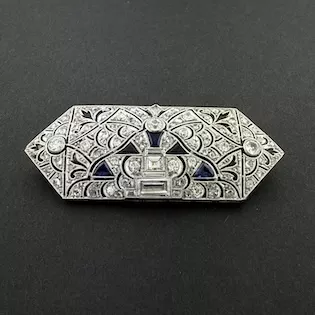
This Art Deco pin shown under normal light
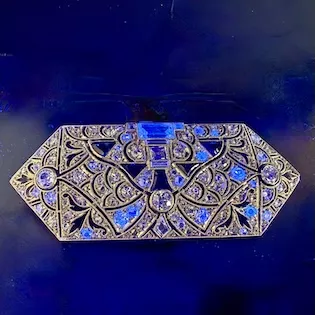
The same pin under UV or Black light
What Is Diamond Fluorescence?
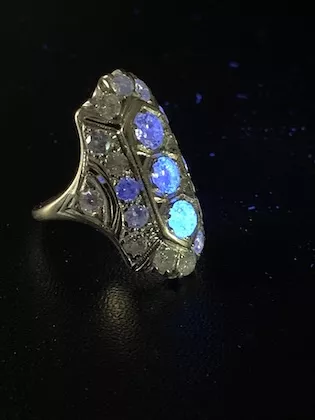
This antique ring shows from the top, Faint, Medium and Very Strong Blue Fluorescence
Fluorescence refers to the visible glow that some diamonds emit when exposed to ultraviolet (UV) light, such as from a blacklight or direct sunlight. About 25–35% of all natural diamonds show some degree of fluorescence, usually blue.
Fluorescence is graded by gem labs such as GIA as:
- None
- Faint
- Medium
- Strong
- Very Strong
Why Diamonds Fluoresce
The glow comes from trace elements and structural irregularities in the diamond crystal lattice — most often nitrogen impurities.¨When UV light excites these atoms, they release energy as visible light, typically in the blue spectrum.
This is a natural property — not a flaw or treatment.
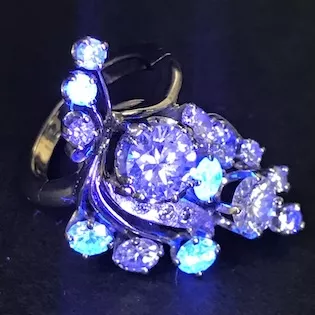
Numerous fluorescent diamonds in a ring
Colors of Diamond Fluorescence
Although blue is the most common color, diamonds can fluoresce in a range of hues, depending on their chemistry:
|
|
Description
|
Rarity
|
|
Blue
|
Most common; can make near-colorless diamonds appear whiter
|
Common
|
|
Yellow
|
May make a diamond appear warmer
|
Rare
|
|
Orange
|
Often seen in fancy color diamonds
|
Rare
|
|
Green
|
Indicates unusual lattice distortion
|
Very rare
|
|
White
|
Gives a milky appearance under UV
|
Rare
|
How Fluorescence Affects Value
Neutral or Positive Effect
- In lower color grades (J–M), faint to medium blue fluorescence can actually improve face-up color, making the diamond look whiter and more appealing.
- Many buyers and jewelers appreciate this subtle effect.
Possible Negative Effect
- In colorless grades (D–F) with strong to very strong fluorescence, some stones may appear slightly cloudy or oily in direct sunlight.
- For this reason, such stones might be priced 5–15% lower, even if the visual impact is minimal or only visible under UV light.
Should You Worry About It?
For most buyers, fluorescence is a non-issue. The best approach:
- View the diamond in different lighting, including sunlight.
- Ask your jeweler to show examples with and without fluorescence.
- Trust your eyes — if it sparkles beautifully, it’s a good choice.
Key Takeaway
Diamond fluorescence is simply part of nature’s fingerprint. Rather than a flaw, it’s a unique trait that can even add charm and value — especially when it enhances a diamond’s apparent whiteness. The real test is always how it looks to you.
FAQ
Does fluorescence mean a diamond is fake?No — fluorescence is a natural property of many genuine diamonds.
Can lab-grown diamonds fluoresce?Yes. Lab-grown diamonds can show fluorescence too, sometimes in colors like orange or green, depending on how they were grown.
Does fluorescence affect sparkle or brilliance?Not directly. Sparkle depends more on cut quality than fluorescence.
Is blue fluorescence desirable?Often yes, especially in near-colorless diamonds. It can make them appear brighter and whiter.